MCR Diabetes & Eye Care · Kannur, Kerala
+91 97444 35552
Diabetes follow-up tests: a yearly checklist for your next review
A folder full of normal-looking reports can still leave you wondering whether your diabetes checks are up to date. A glucose result answers a different question from a kidney test, an eye examination or a foot assessment. Use your next review to make a dated plan for each, rather than ordering the same bundle of tests every year without knowing what happens afterwards.
Start with the checks you have already had
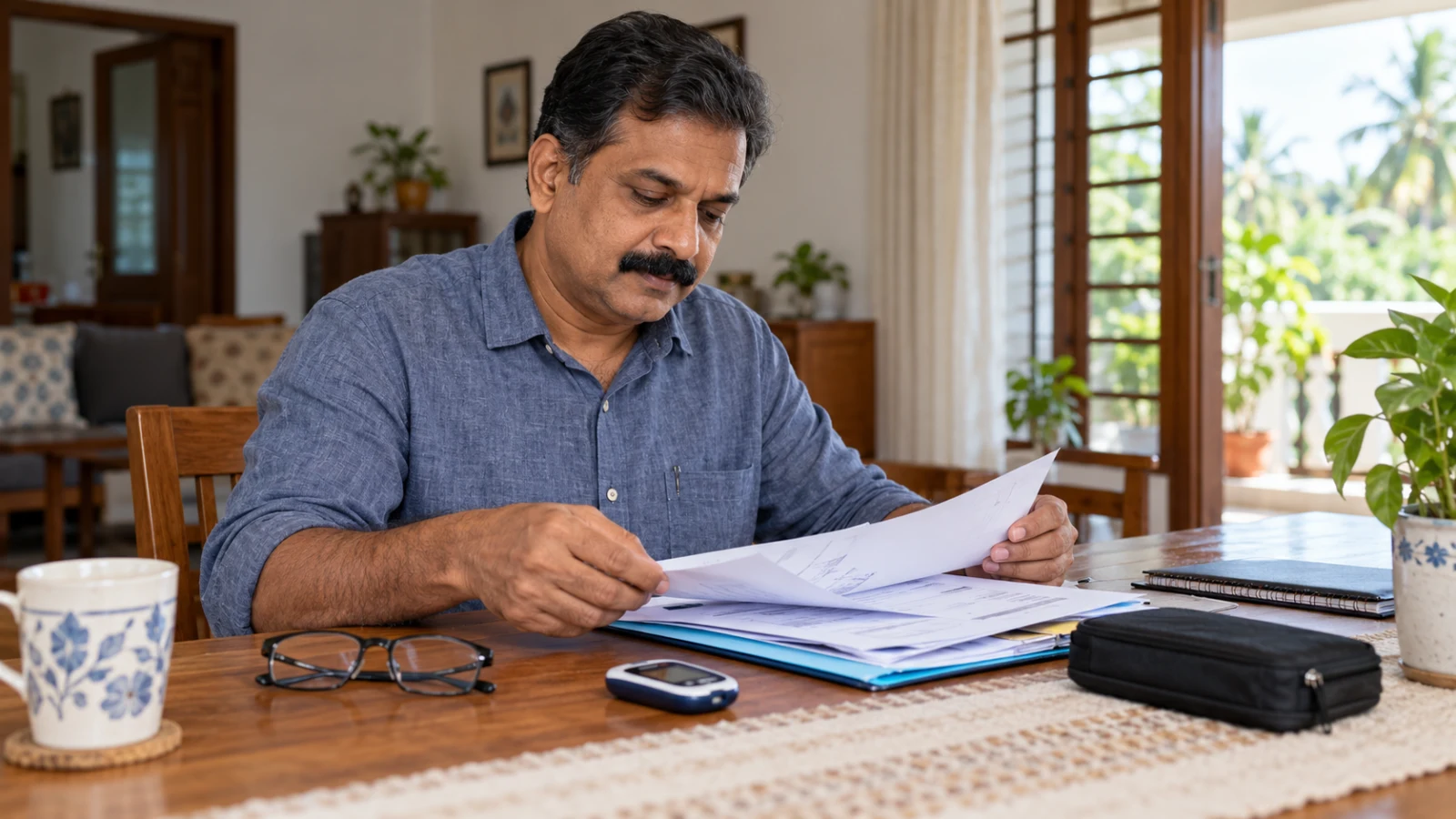
Put recent reports in date order. Include results from another hospital, an eye clinic or a workplace health check, even if they are stored in different apps. Write the date of your last foot examination and dental visit on the folder. A missing paper does not always mean a missing test, but the clinician needs enough information to judge whether an assessment should be repeated.
Bring the prescription you currently follow. If you take a different amount from the printed instruction, say so. Include medicines bought elsewhere and supplements. This is a working record of your care, not an examination in which you have to give the right answer.
Blood sugar monitoring and HbA1c have different jobs
Home readings describe particular moments. HbA1c gives a longer view of blood glucose over roughly three months. The test usually does not require fasting, although another test booked at the same visit might. Anaemia and some other conditions can affect interpretation, so an unexpected HbA1c deserves a discussion rather than a hurried treatment decision. [1]
Bring the dates and circumstances of unusual readings. A note about a missed lunch, illness or an overnight alarm may be more useful than a list of isolated numbers. If you use a sensor, ask how to share the report for the requested period. Do not change your routine for a few days merely to make the appointment look better.
The CDC lists HbA1c checks every three months when treatment has changed or goals are difficult to meet, and every six months when goals are being met. Your own schedule may differ. Ask the clinician to write the next date and the reason for it. A yearly checklist does not mean every test should happen only once a year. [2]
Ask about both parts of a kidney assessment
A kidney review can involve a blood test estimating filtration, called eGFR, and a urine test looking for albumin, often reported as uACR. These provide different information. Kidney damage may develop without obvious symptoms, which is why feeling well is not a reliable reason to omit the recommended checks. [3]
If the request form just says "kidney test", ask which sample is needed. Some people arrive having had blood collected but without knowing that a urine sample was also requested. Keep the results together, including the laboratory units. If a result needs repeating, record when the repeat should happen and who will discuss it with you.
Eye and foot assessments are more than symptom checks
Diabetes follow-up includes an eye assessment and a complete foot examination. The frequency depends on earlier findings and risk. The American Diabetes Association's comprehensive evaluation guidance also includes reviewing cardiovascular risk, medicines, nutrition, mental health and the person's ability to carry out their care plan. [4]
Tell the team whether an eye visit was for a spectacle prescription, retinal photography or a fuller examination. Those descriptions help avoid assuming that every eye appointment covers the same ground. For a foot review, mention numbness, a change in footwear fit, a blister or a wound, even if it no longer hurts.
Keep referral letters in the same folder as test results. If someone recommends another appointment, ask what it is for and how soon you should arrange it. An unexplained instruction to "see the specialist" is difficult to act on when you also have work and travel to organise.
Use the visit to review the treatment you actually live with
Tests cannot describe every difficulty. You may be delaying tablets because breakfast is unpredictable, avoiding a walk because of foot discomfort, or finding the cost of strips hard to manage. Write the problem in plain language before the appointment. A specific obstacle gives the team something to work on.
Include low glucose episodes, side effects and changes in sleep or appetite. Ask which symptoms need a call before the next scheduled visit. If your plan involves monitoring that you cannot obtain regularly, say what is available to you. A monitoring schedule should be usable after you leave the clinic.
A simple record is easier to maintain than a perfect one
You could keep one page with four columns: the check, the date completed, the result or report location, and the next action. Add a name or service beside any result that needs follow-up. Paper is fine. A phone note is fine too, provided you can find it and share it when needed.
For a family member who helps with appointments, agree what they should organise and what information you want to keep private. They might arrange transport or file reports without taking over the consultation. Bring your own questions to the top of the page so they are not lost in the paperwork.
Before booking a package, ask what is due
A list of included tests is not a personal care schedule. Show your recent results before paying to repeat them. Ask which tests are due now, which can wait, whether any need preparation and whether interpretation is included. Current package contents, prices and appointment arrangements should be confirmed directly with the clinic.
Before the visit ends, repeat the plan back in your own words: "I will have this sample collected, bring the report to that appointment, and call sooner if this happens." That short check often exposes an uncertainty that would otherwise become a missed follow-up.
Remember: A follow-up checklist joins together results, examinations and a next action. Collecting reports alone does not complete the review.
When to get help: New symptoms or a deteriorating foot, vision or glucose problem should be assessed when they occur. Do not wait for an annual package or a routine review slot.
Building your next review list
| Situation | A useful next step |
|---|---|
| A recent report is already available | Bring it before paying to repeat the test. |
| A urine test was requested | Confirm the collection instructions and return plan. |
| An examination led to a referral | Record its purpose and recommended timing. |
| Your routine or medicine has changed | Explain the change and any practical difficulties. |
| A result needs follow-up | Write who will review it and when. |
Questions people ask
Do I need every diabetes test every year?
No. Some checks may be due more often and others depend on your history or recent results. Ask for a personal schedule. A general checklist helps organise the conversation; it cannot decide which investigations you need.
Should I fast for my review?
Check the instructions for the tests actually ordered. HbA1c itself usually does not need fasting, but another sample might. Ask what to do about food and medicines before attending; do not invent a fasting routine from the appointment time.
Are normal home readings enough?
Home readings are useful, but they do not replace every recommended examination or laboratory test. Bring the record and ask what it shows alongside your other results. The question is whether the whole follow-up plan is current.
Can I use reports from another laboratory?
Bring them, with their dates and units. The clinician can decide whether they answer the current question or need confirmation. Do not discard a useful report just because it came from a different provider.
What if I cannot afford all the tests together?
Tell the clinician before booking. Ask which assessments have priority and how to organise the rest. Explain any travel or work constraints too, so the plan does not depend on several visits you cannot make.
What should I leave the appointment knowing?
You should understand which result needs action, what treatment instructions to follow, the next review date and who to contact about problems. Ask for an explanation of any abbreviation or instruction that is unclear.
What to take away
For your next review, bring a dated folder and one page of questions. Leave with a short list of checks that are actually due, a way to obtain the results and a clear follow-up date. That is more useful than a larger stack of unexplained tests.
Discuss your diabetes care in Kannur
Bring your reports and everyday questions to MCR Diabetes & Eye Care. Contact the clinic to ask about a diabetes review and current appointment availability.
Enquire about an appointment →Related reading
- Preparing for your first diabetes consultation
- What kidney function tests measure
- Diabetes care at MCR
Sources and further reading
- NIDDK: The A1C Test and Diabetes.
- CDC: Your Diabetes Care Schedule.
- NIDDK: Diabetic Kidney Disease.
- ADA: Comprehensive Medical Evaluation, Standards of Care 2026.
Sources checked on 30 October 2026. This article provides general education; your care team should tailor advice to your health and treatment. The AI-generated cover shows fictional people and settings.