
MCR Diabetes & Eye Care · Kannur, Kerala
+91 9497 222 722
Insulin Therapy Guide: Types, Injection Technique, Storage, and Common Mistakes
For many patients, being told they need insulin feels like a defeat. It is not. Insulin is the most effective glucose-lowering treatment available, and for type 1 diabetes it is not optional at all. What matters is using it correctly — and a surprising amount of poor diabetes control traces back not to the wrong dose, but to injection technique, site rotation, or storage errors that nobody ever explained. Our specialist team at MCR Diabetes & Eye Care, Kannur, gives you the complete practical guide.
Evidence-based clinical note: Storage time and temperature limits vary by insulin product, so the manufacturer’s label controls. Unopened insulin is generally refrigerated at 2–8°C; never freeze it. Kerala heat can exceed in-use limits, so use temperature-controlled storage or a purpose-made cooling pouch without direct contact with ice. Use a new needle for every injection.
4 mm
needle length suitable for most adults
28 days
shelf life of an in-use pen at room temperature
10 seconds
hold time after injecting
Every dose
how often to change the needle
India’s climate adds a challenge most international guidance ignores: insulin is a protein, and heat destroys it. A pen left in a car in Kannur in April can lose potency without any visible change, leaving a patient and doctor puzzling over “resistant” blood sugars. Understanding storage, technique, and timing turns insulin from a frustrating burden into a precise tool. For an overview of all treatment options, see our diabetes medications guide.
The Types of Insulin
Insulins are classified by how quickly they start working and how long they last.
| Type | Examples | Onset | Duration |
|---|---|---|---|
| Rapid-acting | Aspart, lispro, glulisine | 10-20 min | 3-5 hours |
| Short-acting (regular) | Human regular insulin | 30 min | 6-8 hours |
| Intermediate (NPH) | Isophane insulin | 1-2 hours | 12-18 hours |
| Long-acting | Glargine, detemir | 1-2 hours | 20-24 hours |
| Ultra-long-acting | Degludec | 1-2 hours | Up to 42 hours |
| Premixed | 30/70, 50/50 mixes | 30 min | 12-16 hours |
Rapid-Acting (Bolus/Mealtime)
Aspart, lispro, and glulisine start working in 10-20 minutes and cover the glucose rise from a meal. Taken shortly before eating. Newer ultra-rapid versions act even faster.
Short-Acting (Regular Human Insulin)
Plain human insulin takes about 30 minutes to start, so it must be taken 30 minutes before the meal — a timing detail frequently missed, causing post-meal spikes followed by later lows. Less expensive than analogues.
Intermediate-Acting (NPH)
Cloudy insulin lasting 12-18 hours, usually given twice daily. Requires resuspension by gentle rolling before every dose. Has a pronounced peak that can cause lows, particularly overnight.
Long-Acting (Basal)
Glargine, detemir, and degludec provide flat background coverage for 20-42 hours. Degludec is the longest and most stable, offering flexibility in dose timing.
Premixed
Combinations such as 30/70 provide both mealtime and background insulin in one injection, typically twice daily. Simpler and cheaper, but less flexible — meals must be reasonably consistent in timing and size.
Key fact: Lipohypertrophy — rubbery lumps from repeated injections in the same spot — is one of the most common hidden causes of unexplained glucose swings. Insulin absorbed from these lumps is erratic and often reduced by 25% or more.
Common Regimens
- Basal only: one long-acting injection daily, added to oral medications in type 2 diabetes. Usually the first step.
- Basal plus: basal insulin plus one mealtime dose with the largest meal.
- Basal-bolus: one basal injection plus rapid-acting insulin before each meal. The most flexible and precise; standard for type 1 diabetes.
- Premixed twice daily: simple, fewer injections, suits patients with regular routines.
- Insulin pump: continuous rapid-acting delivery with mealtime boluses, increasingly paired with CGM.
Correct Injection Technique
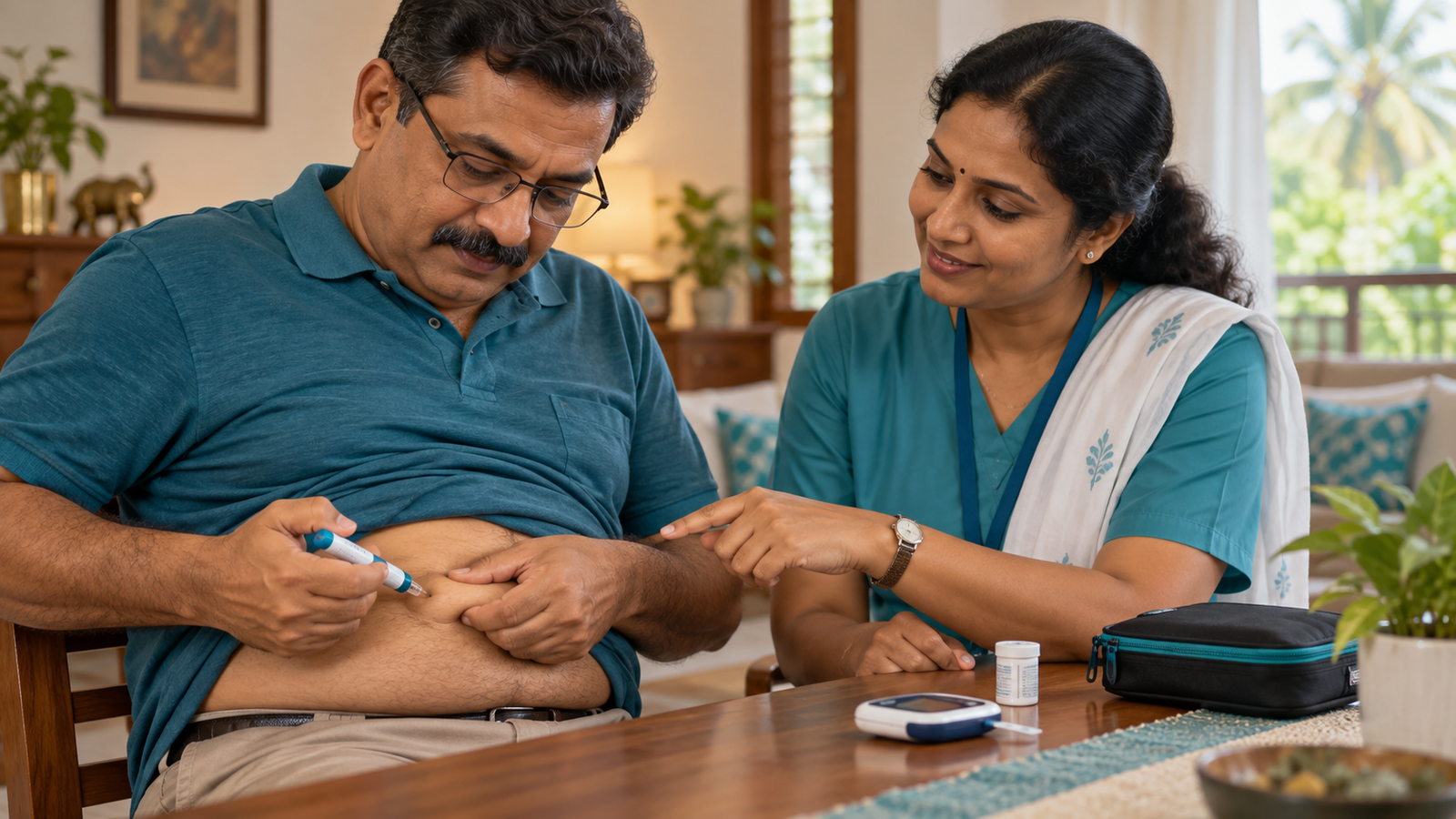
Technique determines how consistently insulin is absorbed. The essentials:
- Wash hands. Alcohol swabbing the skin is not required for routine home injections and can toughen skin over time.
- Check the insulin. Clear insulins should be perfectly clear; cloudy insulins should be uniformly milky after gentle rolling. Discard anything clumped, frosted, or discoloured.
- Prime the pen. Dial 2 units and press until a droplet appears at the needle tip. This clears air and confirms flow — skipping it is a common cause of underdosing.
- Use a new needle every time. Reused needles bend, blunt, and dramatically increase lumps under the skin.
- Inject into subcutaneous fat, not muscle. With 4 mm needles, most adults can inject straight in at 90 degrees without pinching. Longer needles or very lean patients need a skin pinch.
- Hold for 10 seconds after pressing the plunger fully, before withdrawing. Removing immediately leaks insulin back out.
- Dispose safely in a puncture-proof container.
Injection Sites and Rotation
Absorption speed differs by site: abdomen is fastest, then upper arm, then thigh, then buttock. Consistency matters more than choosing the “best” site — use the same body region for the same insulin at the same time of day.
Rotation is critical. Injecting repeatedly into the same spot causes lipohypertrophy — rubbery fatty lumps that look harmless but absorb insulin erratically. Injecting into these lumps is one of the most common hidden causes of unexplained glucose swings.
- Divide each region into quadrants; use one quadrant per week
- Within a quadrant, space injections at least 1 cm apart
- Examine and feel your injection sites monthly for lumps
- If lumps are present, stop using that area for several months and expect to need less insulin once you move to healthy tissue
⚠ Important: Insulin is a protein and heat destroys it silently — a pen left in a car or near a stove can lose potency with no change in appearance. Frozen insulin is permanently ruined even after thawing. In Kerala’s climate, store in-use pens in the fridge and take them out 15-30 minutes before injecting.
Storing Insulin in Kerala’s Climate
This is where Indian patients need guidance that imported leaflets rarely provide.
Unopened Insulin
Store in the refrigerator at 2-8°C — in the main body of the fridge, never the freezer compartment or against the back wall where freezing can occur. Frozen insulin is permanently destroyed even after thawing.
In-Use Insulin
Many in-use insulin products can be kept outside the refrigerator for a limited time, but the allowed duration and maximum temperature vary. Check the label for your exact brand and device; many Kerala homes exceed those limits in summer. Practical options:
- If the product label allows refrigeration after first use, it may be kept refrigerated and brought toward room temperature before injecting; otherwise use a validated cooling pouch that keeps it within the labelled range
- Use a clay pot (matka) or an insulin cooling pouch for travel and power cuts
- Never leave insulin in a car, on a windowsill, or near a stove
- Note the date you opened each pen; discard after 28 days even if insulin remains
Travel
Carry insulin in hand luggage, never checked baggage — cargo holds freeze. Carry a doctor’s letter for security. Bring roughly double the insulin you expect to need, split between two bags.
Common Mistakes That Quietly Wreck Control
- Not priming the pen — delivers less than the dialled dose
- Reusing needles — blunt needles cause pain, bruising, and lipohypertrophy
- Injecting into lumps — the most common cause of unexplained erratic sugars
- Not rolling cloudy insulin — delivers either weak or highly concentrated doses
- Wrong timing with regular insulin — must be 30 minutes before eating, not at the table
- Withdrawing the needle too fast — insulin leaks out of the skin
- Using expired or heat-damaged insulin — looks normal, works poorly
- Skipping doses when not eating — basal insulin is still needed; see our blood sugar control guide
- Confusing the two pens — keep basal and bolus pens visibly distinct
Insulin Training and Technique Review
Hands-on injection training, site examination for lumps, and regimen simplification tailored to your routine and budget.
Managing Hypoglycemia Risk
Insulin is the medication most likely to cause low blood sugar. Every insulin user should know the Rule of 15 and keep fast-acting glucose within reach at all times — see our complete guide to hypoglycemia symptoms and treatment. Family members should know where your supplies are and how to help.
Exercise adds another layer: insulin sensitivity rises during and for up to 24 hours after activity, so doses often need reducing on active days. Our exercise guide for diabetics covers the adjustments.
Insulin and Weight Gain
Some weight gain when starting insulin is common — partly because glucose previously lost in urine is now retained as calories. It is manageable rather than inevitable:
- Avoid over-correcting lows, which drives a cycle of extra calories
- Keep metformin alongside insulin where appropriate
- Consider combining with GLP-1 agonists or SGLT2 inhibitors where indicated
- Maintain resistance training to preserve muscle — see our weight management guide
Insulin Therapy at a Glance
| Aspect | Key Point |
|---|---|
| Needle reuse | Never — new needle every injection |
| Priming | 2 units before every dose until a droplet appears |
| Injection depth | Subcutaneous fat, not muscle |
| Hold time | 10 seconds before withdrawing |
| Rotation | New site 1 cm apart; one quadrant per week |
| Unopened storage | Fridge 2-8°C, never the freezer |
| In-use storage | 28 days; fridge is safest in Kerala heat |
| Travel | Hand luggage only; carry double supply |
| Regular insulin timing | 30 minutes before the meal |
| Cloudy insulin | Roll gently to mix before every dose |
Frequently Asked Questions
Below are the questions our patients ask most often. If you have additional questions, our specialist team at MCR Diabetes & Eye Care, Kannur, is always available to help.
Does starting insulin mean my diabetes has become severe?
No. In type 2 diabetes, beta cell function declines naturally over time — needing insulin reflects the natural history of the condition, not personal failure. Many patients feel dramatically better within weeks of starting.
Will I be on insulin forever once I start?
Not necessarily in type 2 diabetes. Insulin is sometimes used temporarily — at diagnosis with very high sugars, during infection, surgery, or pregnancy — and stopped afterwards. Substantial weight loss can also reduce or remove the need.
Do injections hurt?
Modern 4 mm needles are extremely fine and most patients describe minimal or no pain. Pain usually indicates a reused needle, cold insulin straight from the fridge, injecting into muscle, or hitting a lump.
Can I reuse a needle just once or twice to save money?
It is not advisable. Needles blunt and bend after a single use, which increases pain, bruising, and — most importantly — lipohypertrophy, which then wrecks absorption and costs far more in wasted insulin and poor control.
What if I forget a dose?
It depends on the insulin type and how much time has passed. This should be worked out in advance with your diabetologist and written down, because the correct action differs for basal and bolus insulin. Never simply double the next dose.
Is it safe to keep insulin in a clay pot instead of a fridge?
A matka or an insulin cooling pouch is a reasonable option where refrigeration is unreliable — evaporative cooling keeps temperatures well below ambient. It is a practical alternative, not a substitute for a fridge when one is available.
Can I inject through clothing if I am in public?
It is not recommended — you cannot see the site, cannot check for lumps or bleeding, and the needle may bend. Discreet injection into the abdomen under a loose shirt is preferable.
Final Takeaway: A Tool, Not a Verdict
Insulin has been saving lives for a century, and modern insulins with fine needles are far removed from the painful, rigid regimens of a generation ago. Most patients who start insulin report feeling dramatically better within weeks — energy returns, thirst settles, and complications stop advancing. The technical details in this guide are what separate insulin that works from insulin that disappoints.
At MCR Diabetes & Eye Care, Kannur, we provide hands-on insulin training, injection site examination at every review, and regimen adjustment tailored to your routine and budget. If you have been advised to start insulin, or your current regimen is not working, book a consultation today.
You May Also Find Helpful
- Hypoglycemia: Symptoms and Emergency Treatment
- Diabetes Medications Explained
- Continuous Glucose Monitoring (CGM) in India
- Type 1 vs Type 2 Diabetes: Key Differences
Sources and Further Reading
Clinical guidance and evidence reviewed for this article:
- American Diabetes Association: Pharmacologic approaches to glycaemic treatment, Standards of Care 2026
- World Health Organization: Thermostability of human insulin—technical brief
- Cochrane review: Thermal stability and storage of human insulin
- Kaufmann et al.: Insulin thermostability in tropical conditions
This article is for education and does not replace individual medical advice.