
MCR Diabetes & Eye Care · Kannur, Kerala
+91 9497 222 722
Home Blood Pressure Monitoring: How to Measure Correctly and What Your Numbers Mean
Home blood pressure monitoring is now considered more reliable than clinic readings for diagnosing and managing hypertension. It removes the white-coat effect, catches masked hypertension that clinics miss entirely, and produces the multiple readings that good decisions require. The problem is that most home readings are taken incorrectly — wrong cuff, wrong posture, wrong arm position, wrong timing — and a wrong reading leads directly to wrong treatment. Our specialist team at MCR Diabetes & Eye Care, Kannur, sets out how to do it properly.
130/80
home target for most diabetics
7 days
twice daily, two readings each time
Upper arm
the only cuff type to buy
Discard day 1
first-day readings run high
For people with diabetes this matters particularly. Blood pressure control often prevents more cardiovascular events than blood sugar control does, and the target is tighter — below 130/80 mmHg for most diabetic adults. Getting accurate numbers is the foundation of hitting that target. See our guide on the hypertension-diabetes connection.
Choosing a Monitor
- Buy an upper-arm cuff monitor, not a wrist device. Wrist monitors are highly position-sensitive and consistently less accurate. Finger monitors should not be used at all.
- Choose a validated device. Look for validation by a recognised body (such as listings on validatebp.org or STRIDE BP) rather than relying on brand alone.[1][2]
- Get the cuff size right. This is the single most common source of error. A cuff that is too small gives falsely high readings; too large gives falsely low ones. Measure your upper arm circumference midway between shoulder and elbow and match it to the cuff range printed on the cuff.
- Automatic (oscillometric) is fine for home use — you do not need a manual sphygmomanometer.
- Memory and averaging functions help but a simple notebook works equally well.
- Cost: a reliable validated upper-arm monitor typically costs ₹1,800-4,000 in India.
Have your device checked against the clinic machine once a year, and after any drop or battery issue.
Key fact: Wrong cuff size is the most common source of error in home monitoring. A cuff that is too small gives falsely high readings and can lead to unnecessary medication; too large gives falsely low readings and hides real hypertension. Measure your arm and match the range printed on the cuff.
The Correct Technique
| Step | What to Do | Error if Skipped |
|---|---|---|
| Empty bladder first | Use the toilet before measuring | Adds 10-15 mmHg |
| Rest 5 minutes | Sit quietly, no phone, no talking | Adds 5-10 mmHg |
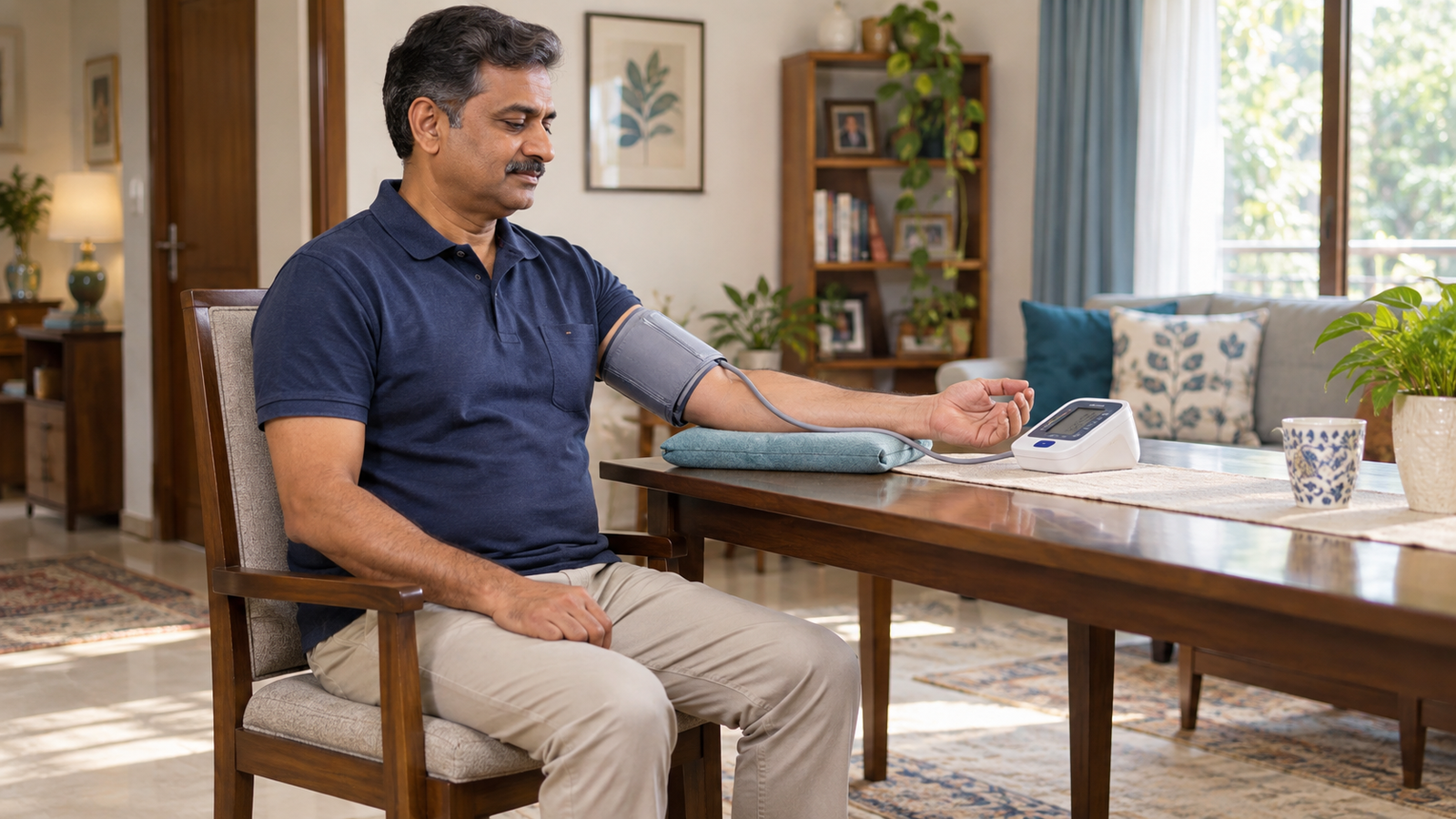
| Sit properly | Back supported, feet flat, legs uncrossed | Crossed legs add 5-8 mmHg |
| Support the arm | Arm on a table at heart level | Unsupported adds up to 10 mmHg |
| Bare arm | Cuff on skin, not over clothing | Thick clothing distorts reading |
| Correct cuff size | Match arm circumference to cuff range | Largest single source of error |
| Stay silent | No talking during measurement | Adds 5-15 mmHg |
| Two readings | One minute apart; average them | Single readings are unreliable |
The errors that matter most, in order of impact: an unsupported arm (can add 10 mmHg), a full bladder (adds up to 10-15 mmHg), talking during measurement (adds 5-15 mmHg), crossed legs (adds 5-8 mmHg), and measuring over thick clothing.
The 7-Day Protocol
A single reading is nearly meaningless. For diagnosis, or before any medication change, use the standard protocol:
- Measure for 7 consecutive days (a minimum of 4 days if 7 is impractical).[1]
- Twice daily — morning (before medication, before breakfast) and evening
- Two readings each time, one minute apart
- Record every reading with date and time
- Discard the entire first day — first-day readings run consistently high
- Average the remaining readings — this average is your home blood pressure
Bring the full log to your appointment, not just the average or the worst reading. Patterns matter — morning surges, evening readings, and day-to-day variability all inform treatment.
⚠ Important: Seek urgent care for a reading above 180/120 mmHg confirmed after five minutes of rest, or for any high reading accompanied by chest pain, breathlessness, severe headache, visual change, one-sided weakness, or difficulty speaking. Isolated high readings without symptoms are common — repeat after resting rather than reacting.
Understanding the Numbers
Home readings run slightly lower than clinic readings, so the thresholds differ:
- Home target for most adults: below 135/85 mmHg
- Treatment target for most people with diabetes: below 130/80 mmHg when it can be safely achieved; the target should be individualised with your clinician.[3]
- Home target for frail older adults: individualised, often below 140/90 mmHg
Two patterns only home monitoring can reveal:
- White-coat hypertension — high in clinic, normal at home. Affects up to a fifth of people diagnosed with hypertension, and can lead to unnecessary lifelong medication.
- Masked hypertension — normal in clinic, high at home. More dangerous because it goes untreated, and notably more common in diabetics.
Special Situations in Diabetes
Postural Drop
Diabetic autonomic neuropathy can cause blood pressure to fall on standing, producing dizziness and falls — particularly in older patients. If you experience light-headedness on standing, measure sitting and then again after standing for one and three minutes, and report the difference. See our elderly diabetes care guide.
Kidney Disease
Blood pressure control is the highest-value intervention for slowing diabetic kidney damage, and home monitoring is how it is verified. See our diabetic nephropathy guide.
Sleep Apnoea
Blood pressure that resists multiple medications frequently points to untreated obstructive sleep apnoea — see our sleep apnoea guide.
Bring Your Monitor and Log
We check device accuracy against clinic equipment and adjust treatment on your real-world readings rather than a single clinic number.
Lowering Blood Pressure Without Medication
These measures have measurable, quantified effects:
- Reduce salt to under 5 g daily — expect 4-6 mmHg. The main sources in Kerala kitchens are pickles, papad, dried fish, and packaged snacks rather than the salt shaker.
- Lose weight — roughly 1 mmHg per kilogram lost
- Regular aerobic exercise — 5-8 mmHg. See our exercise guide.
- Increase potassium-rich foods — vegetables, fruit, coconut water in moderation (avoid if you have kidney disease)
- Limit alcohol — 4 mmHg for heavy drinkers who cut back
- Stop smoking — essential for overall cardiovascular risk
- Manage stress and sleep — see our guide on stress and blood sugar
When to Seek Urgent Care
- A reading above 180/120 mmHg, confirmed after 5 minutes of rest
- Any high reading accompanied by chest pain, breathlessness, severe headache, visual changes, weakness on one side, or difficulty speaking
- Blood pressure below 90/60 mmHg with dizziness, confusion, or fainting
Isolated high readings without symptoms are common and rarely an emergency — repeat after resting rather than reacting to a single number.
Home BP Monitoring at a Glance
| Aspect | Key Point |
|---|---|
| Device type | Validated upper-arm cuff (never wrist or finger) |
| Cost | ₹1,800-4,000 for a reliable monitor |
| Protocol | 7 days, twice daily, 2 readings each time |
| Timing | Morning before medication; and evening |
| Discard | All of day 1 |
| Home target (most adults) | Below 135/85 mmHg |
| Home target (diabetics) | Below 130/80 mmHg |
| White-coat hypertension | High in clinic, normal at home |
| Masked hypertension | Normal in clinic, high at home — more dangerous |
| Salt reduction effect | 4-6 mmHg from under 5 g daily |
Frequently Asked Questions
Below are the questions our patients ask most often. If you have additional questions, our specialist team at MCR Diabetes & Eye Care, Kannur, is always available to help.
Why are my home readings lower than the clinic readings?
This is normal and expected — clinic settings raise blood pressure in many people. That is why home targets are set slightly lower than clinic targets, and why home readings are now considered more reliable for treatment decisions.
How many readings do I actually need?
For diagnosis or before a medication change, use the 7-day protocol: twice daily, two readings each time, discarding the first day and averaging the rest. For routine monitoring once stable, a few days each month is usually sufficient.
Are wrist monitors acceptable if I find arm cuffs uncomfortable?
They are much less accurate because wrist position relative to the heart strongly affects the reading. If arm cuffs are uncomfortable, the cuff is probably the wrong size — a correctly sized cuff should not be painful.
My readings vary a lot between measurements. Is that a problem?
Some variability is normal — blood pressure genuinely fluctuates through the day. That is exactly why averages across multiple days matter more than any single reading. Very large swings are worth showing to your doctor.
Should I measure before or after taking my tablets?
Morning readings should be taken before your morning medication, which shows the trough level of control. Record the timing consistently so your doctor can interpret the pattern.
Do I need to monitor if my BP has always been normal?
If you have diabetes, yes — masked hypertension (normal in clinic, high at home) is notably more common in diabetics, and it goes untreated precisely because clinic readings look fine.
How often should the monitor be checked for accuracy?
Once a year against the clinic machine, and after any drop or battery problem. Bring your device to an appointment and we can compare readings directly.
Final Takeaway: Good Data, Better Decisions
A validated upper-arm monitor, the correct cuff size, five minutes of quiet sitting, and a written 7-day log will tell your doctor more than a dozen rushed clinic readings. For diabetics in particular, where the blood pressure target is tighter and the stakes for kidneys and heart are higher, this is one of the highest-value habits available.
At MCR Diabetes & Eye Care, Kannur, we review home BP logs at every diabetes visit, check monitor accuracy against clinic equipment, and adjust treatment on real-world data rather than single readings. Bring your monitor and log to your next appointment.
You May Also Find Helpful
- The Hypertension-Diabetes Connection
- Diabetic Nephropathy: Kidney Disease Stages
- Diabetes and Heart Disease
- Sleep Apnea and Diabetes
Evidence note: NICE recommends two seated readings at least one minute apart, morning and evening, for at least four days and ideally seven, discarding day one. The ADA recommends home monitoring for people with diabetes and hypertension, following appropriate education.[1][3]
Sources and Further Reading
- NICE. Hypertension in adults: diagnosis and management (NG136).
- World Health Organization. Technical specifications for automated blood-pressure devices with a cuff.
- American Diabetes Association. Cardiovascular Disease and Risk Management: Standards of Care in Diabetes—2026.
- Systematic review and meta-analysis of home blood-pressure self-measurement (2024).